
Integrating Story Content to Drive SEO Success
Connecting program and service information pages with news and PR stories to boost search visibility and audience engagement.

One of the most effective ways I’ve improved SEO performance and audience engagement is by connecting owned content (program pages and student support content) with earned content (news stories, press releases, alumni profiles, digital magazine articles, etc).
At both Carroll University and Madison College, I led the design of functional requirements that allowed news stories to dynamically appear on relevant academic program and student services pages. This approach marries storytelling with search optimization:
- Stories provide context by adding human narratives and successes to otherwise static program information.
- Cross-linking improves SEO. When articles link to program pages, and program pages reciprocate links, search engines identify richer connections and greater authority.
Matching search intent with more relevant content appearing in search results, users land directly on the information they’re looking for.
How It Worked at Carroll University
I collaborated with cross-functional teams of content authors, designers and developers to implement a topic-based tagging system:
- Each story, whether a press release, alumni profile, or digital magazine article — could be tagged with related topics like “cross-cultural experiences,” “nursing” or “history”.
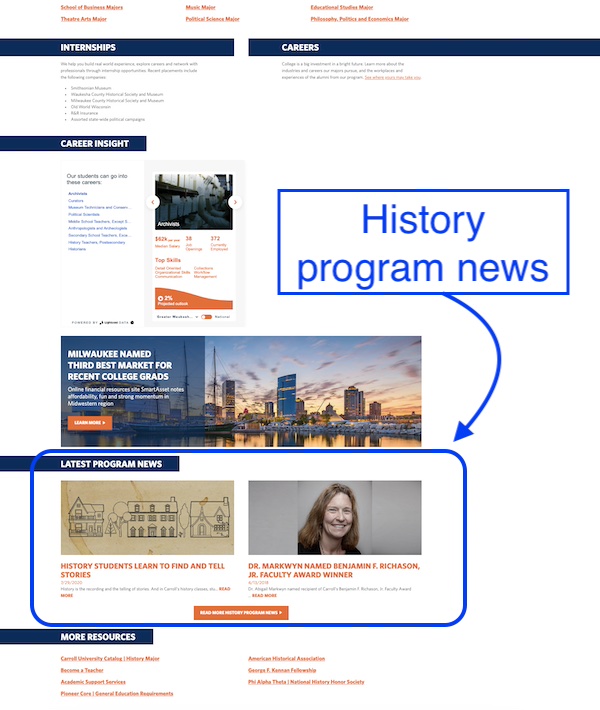
- Program and service pages used dynamic widgets to display the most recent, relevant stories based on these tags.
- Dynamic article widgets could be placed on program and service pages to display the most recent, relevant stories based on these tags.
- Each article required a title, short description and open graph–optimized thumbnail image (1200×630 pixels), ensuring content displayed beautifully when shared on social channels.
The Results
The results were immediate and significant:
- Organic traffic increased year-over-year across the site.
- Traffic to the homepage dropped 60% — a positive indicator that search engines were driving users directly to deeper, more relevant pages.
- Engagement improved because visitors were discovering richer, contextual content aligned with their interests.
Carroll University Examples
- Their Nursing program page includes a “Latest Program News” section featuring two program-related stories with a link to view additional “nursing”-tagged stories.
- Their Cross-Cultural Experiences page includes a “Featured Articles” section promoting “cce”-tagged stories.
Extending the Strategy to Madison College
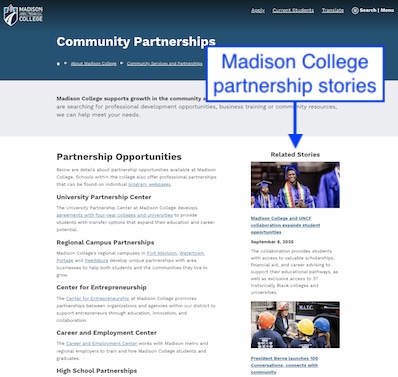
Building on Carroll’s success, I introduced the same tactic at madisoncollege.edu. By integrating dynamic story content into academic and student services pages, program information can be positioned within a broader narrative, boosting both visibility and engagement while further strengthening SEO performance.
View these examples of stories cross-promoted with marketing content on Madison College’s prospective student website:
Why It Matters for Campaign ROI
This tactic shows how an integrated marketing approach can amplify results. By connecting web content, SEO, PR and social into a cohesive strategy, organizations create experiences where each channel strengthens the others.
By aligning storytelling with technical SEO best practices, I helped teams deliver content that ranks higher, drives more qualified traffic and increases engagement — ultimately boosting ROI without requiring additional budget or resources.
Better Integration = Stronger Paid Performance
Connecting owned and earned content doesn’t just improve SEO — it makes every ad dollar work harder for you. Rich, relevant content strengthens landing pages, improves quality scores and boosts conversions across paid campaigns.
Quick Tips for Maximum Impact
As part of designing these integrations, I helped guide editors and story authors on how to write for the web so the technology delivers real results. Integrating stories into program and service pages boosts SEO and engagement, but technology alone isn’t enough. Success depends on how you write and present your content:
Write Click-Worthy Headlines and Descriptions
When stories appear alongside product information, clarity matters. Write clear, engaging titles and short, scannable descriptions that encourage clicks to learn more, without distracting from the product details.
Use Optional Fields for Widgets
If your editorial guidelines require long-form titles or summaries, add optional fields in your CMS for widget-specific content. This lets you display shorter, optimized headlines and descriptions where space and clickability matter most.